
Science
Text
Science Teachers
Miss P Lee (Head of Science)
Mr A Araim
Dr Y Hamidizadeh
Mrs C Maher
Mr I O’Brien
Ms J Pearce
Mrs L Penney
Mr S Pritchard
Mr D Steele
Mr M Webber
Miss F Williams
A Vision for Science
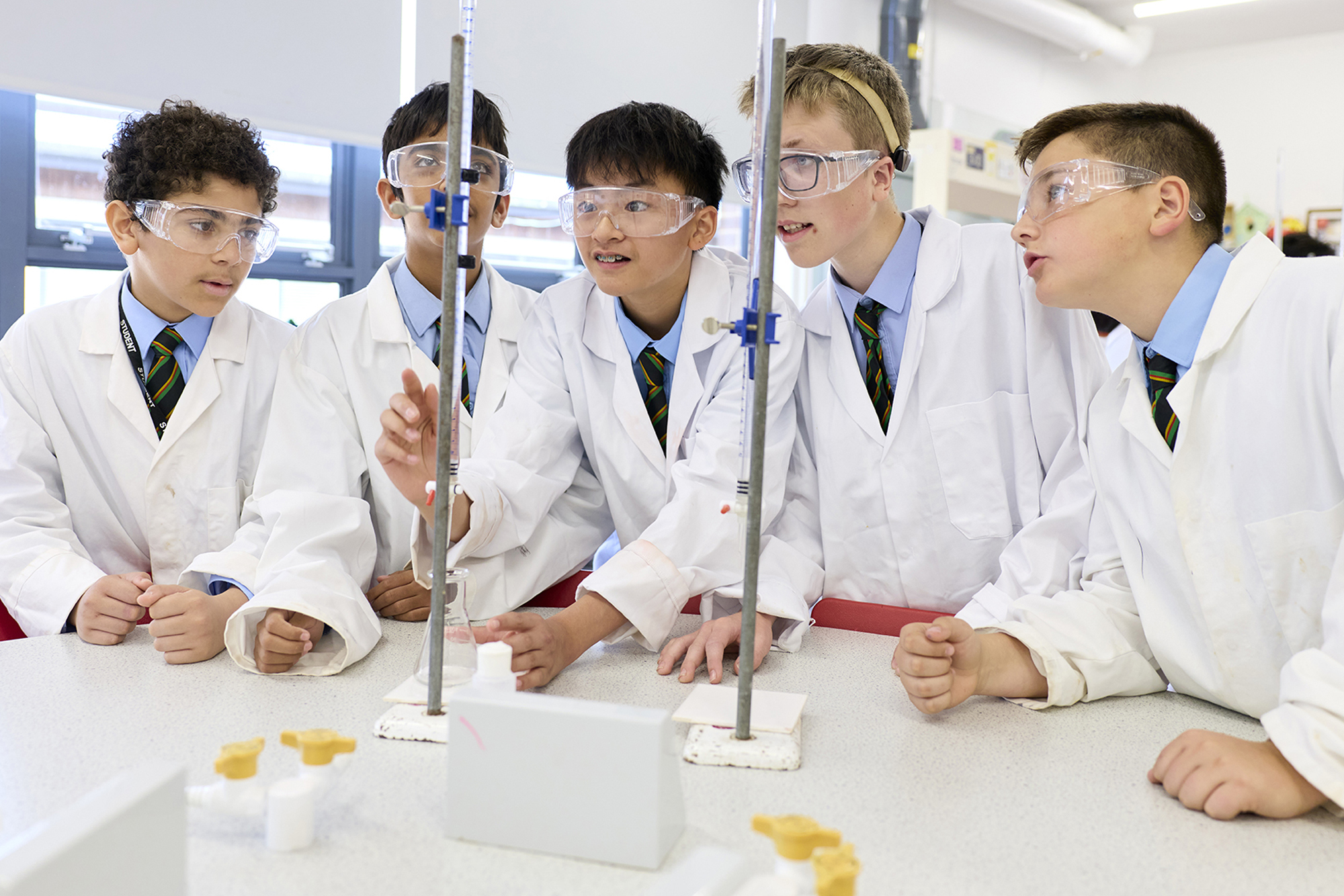
Our students study Science to cultivate awe and mystery through their learning. Studying Science at Richard Challoner will foster habits of careful observation, critical thinking and moral reflection in our students. Our students will gain an understanding of the basic science principles that inform some of the most contentious and important discussions of the day (e.g. pandemic control, global warming and use of nuclear power), and of the future.
Learning science will improve practical skills and understanding of the scientific method through implementation, design and interpretation of experiments. Our students will enhance their scientific information literacy and scientific communication (oral and written).
We are actively preparing students to meet future pathway goals be they career, third level education or post-16 as evidenced in examination success or through developing the wide range of interdisciplinary transferable skills. By developing intellectual ability, technical knowledge, quantitative reasoning, logical thinking and communication skills our students are prepared to excel in a wide array of careers and to be informed and engaged citizens, contributing positively to society.
Expanders
-
KS3
Year 7:
-
TTM1: Cells and their behaviour
-
TTM2: Forces and Waves
-
TTM3: Chemical Reactions and Acids and Alkalis
-
TTM4: Human and Plant Reproduction
Year 8:
-
TTM1: Health and Lifestyle
-
TTM2: Periodic Table and Reactions of Metals
-
TTM3: Electricity and Separation Techniques
-
TTM4: Biological Processes and Ecosystems
Year 9: These topics are taught in 7-week rotation blocks...
-
TTM1: Genetics and Inheritance
-
TTM2: Rates of Reaction
-
TTM3: Space and Beyond
-
-
KS5
BIOLOGY: A Level
Subject Leader: Mrs L Penney
Teachers: Mr L Penney, Mr M Webber and Miss P Lee
OCR
Course Content: Studying A level Biology will give learners the opportunity to use microscopy to study the cell structure of a variety of organisms. Biologically important molecules such as carbohydrates, proteins, water and nucleic acids are studied with respect to their structure and function. The structure and mode of action of enzymes in catalyzing biochemical reactions is studied. The division and subsequent specialization of cells is studied, together with the potential for the therapeutic use of stem cells. Also learners study some human and plant physiology to include the structure and function of gas exchange and transport systems. Students also study the biodiversity of organisms; how they are classified and the ways in which biodiversity can be measured. The relationships between organisms are studied, considering variation, evolution and phylogeny. Learners will be required to develop a range of practical skills throughout their course in preparation for the written examinations. Students build on this knowledge and understanding by studying topics such as communication, homeostasis and energy and also genetics, evolution and ecosystems. Learners will be required to develop a range of practical skills throughout the course. Practical work in Biology is significant and routine. It is assessed in the final examinations and there is also a practical skills endorsement which is awarded separate to the final A level grade.
CHEMISTRY: A Level
Subject Leader: Ms J Pearce
Teachers: Mrs C Maher, Ms J Pearce and Mr S Pritchard
OCR
Course Content: The Chemistry A level is made up of six modules:
-
Module 1: Development of Practical Skills in Chemistry
-
Module 2: Foundations in Chemistry
-
Module 3: Periodic Table and Energy
-
Module 4: Core Organic Chemistry
-
Module 5: Physical Chemistry and Transition Elements
-
Module 6: Organic Chemistry and Analysis
Through the study of these modules, students will develop knowledge, understanding and application of a range of ideas in Chemistry, including ideas of atoms and molecules, environmental aspects, manufacturing processes and the importance of Chemistry to the economy and society.
Practical skills are assessed continuously throughout each course with a series of Practical Activity Groups (PAGs). There are 8 PAGs at AS level and 12 PAGS at A Level.
The development of wider skills such as Maths skills and How Science Works Skills are also assessed throughout the course and in the final exams.
PHYSICS: A Level
Subject Leader: Dr Y Hamidizadeh
Teachers: Dr Y Hamidizadeh and Mr I O’Brien
OCR
Course Content: Candidates are expected to bring together the principles and concepts from different areas of physics and apply them in a particular context, expressing ideas clearly and logically and using specialist vocabulary. They are also expected to use analysis and interpretation in contexts which may be unfamiliar to them. Modules studied include:
-
Development of Practical Skills
-
Foundations of Physics
-
Forces and Motion
-
Electrons, Waves and Photons
-
The Newtonian World and astrophysics
-
Particles and medical physics
-